
This time, we’re introducing Shumatsu no Jinrui ni Bunmei wa Hitsuyō desu ka?—a compact, beginner-friendly sci-fi manga that’s perfect for learning natural, casual Japanese through fast-paced dialogue.
Work Information
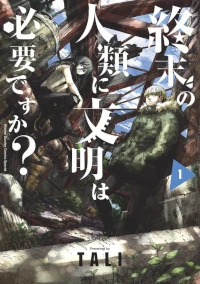
Shumatsu no jinruini bunmei ha hitsuyo desuka? (終末の人類に文明は必要ですか?)
Author: TALI
Publisher: SHOGAKUKAN
Amount of text: sparse
Challenge level: ★
Latest volume : Vol.4(Oct.2023 / Completed)
Story overview
Humanity versus God—this is a battle over civilization itself.
In the year 20XX, the world has reached its end. In this ruined land ruled by beings known as “God,” the remaining humans scrape by, barely surviving. Although humanity has dwindled to a small population, a boy named Kasago devoutly believes in God. Hoping to be elevated into a higher existence called an “Angel,” he works as a civilization collector, a job in which he obediently strips humans of the remnants of their civilization.
During one of these missions, Kasago meets Mebaru, a sharp-tongued boy who openly questions and resists God, never hiding his doubts about the world they live in. Kasago searches for the parents who abandoned him, while Mebaru seeks revenge against the person who killed his own parents. As these two opposites travel together and encounter fragments of lost civilization, they gradually begin to uncover the true structure of their world.
Filled with witty, rapid-fire dialogue that sometimes feels like a stand-up comedy routine, this is a strange and lively journey through an apocalyptic world.
The Appeal of This Manga
This manga is a dystopian story set in a world after the collapse of civilization. Although the characters are frequently drawn into dangerous and unsettling situations, the pop-art visual style and lively, lighthearted characters keep the story feeling energetic and engaging, leaving readers with a surprisingly refreshing aftertaste.
The series blends multiple genres: science fiction, a boy-meets-girl story, and a survival tale about enduring life in a ruined world. Since the story is already complete in four volumes, it’s compact and easy to read from start to finish.
There’s also a curious sense of early Heisei-era nostalgia—visible both in the items that appear in the story and in the overall artistic style. This nostalgic atmosphere gives the manga a unique charm, making it especially appealing to older readers as well.
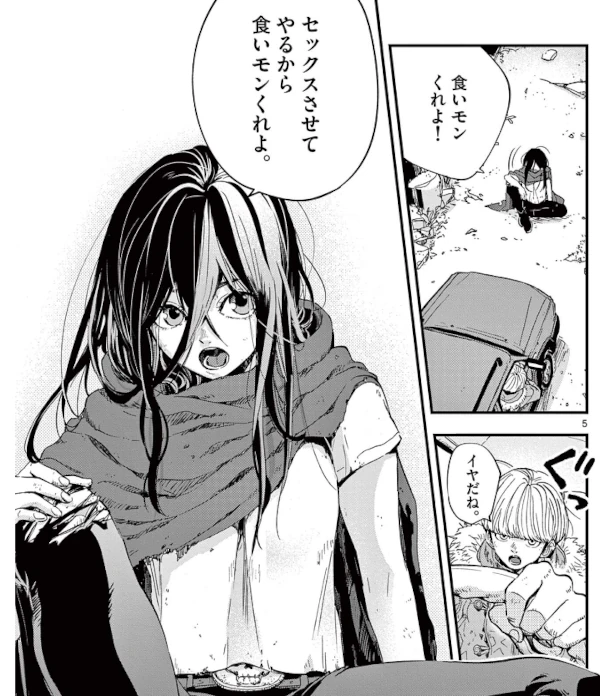
Why this manga is suitable for learning Japanese
This manga is not only entertaining but also highly recommended for Japanese learners for several reasons.
A Manageable Amount of Text
Throughout the series, the amount of text is relatively small, and much of it consists of everyday conversation. This makes the manga quite approachable even for beginner-level Japanese learners.
Although it’s categorized as science fiction, it avoids heavy use of technical jargon, made-up terminology, or long explanatory passages. Even readers who usually struggle with SF may find it accessible.
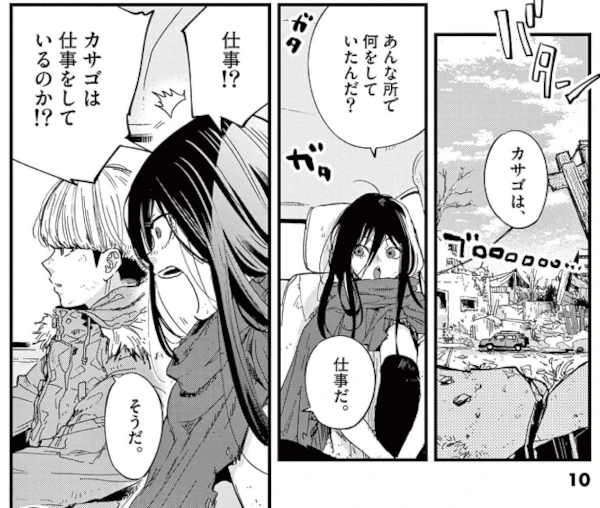
Fast-Paced, Natural Dialogue
The banter between the two main characters, Kasago and Mebaru, is quick, sharp, and highly engaging. Since polite speech and honorifics appear only rarely, the manga serves as a good example of casual Japanese used between people who are emotionally close and comfortable with each other.
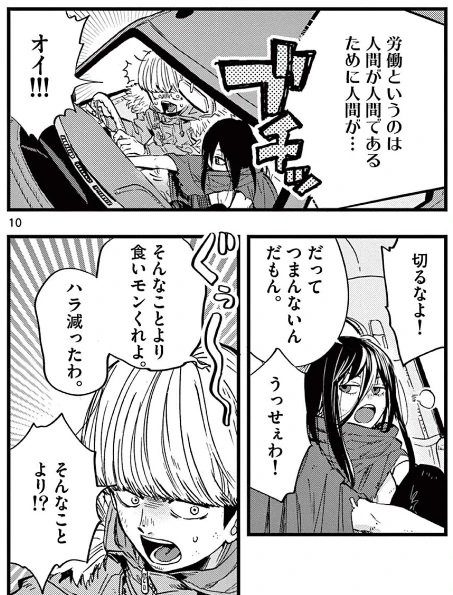
Culture Spotlight
Retro Futures: How Late Shōwa–Early Heisei Pop Culture Still Shapes Japanレトロカルチャー
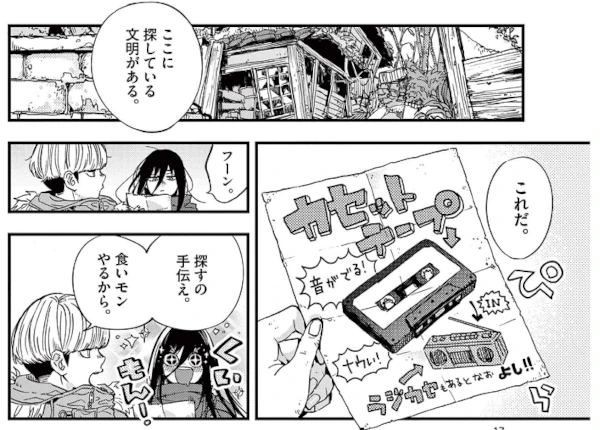
In the manga introduced here, the protagonist searches for objects that symbolize the civilization that existed before the world’s collapse. These items are meant to be offered to God—but they are not futuristic machines or advanced technology.
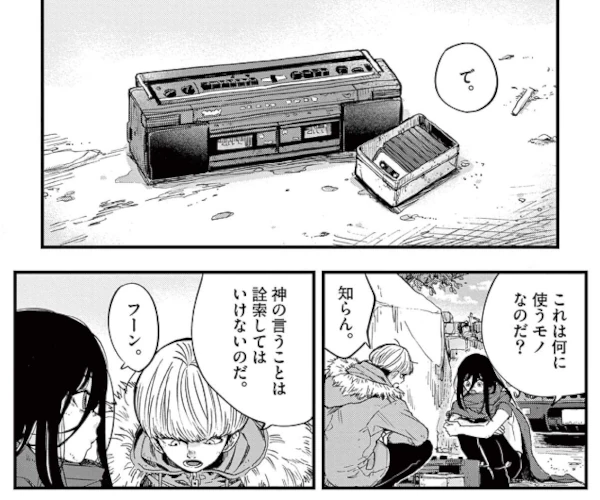
Instead, they are very familiar things from everyday life in late Shōwa to early Heisei Japan: radio cassette players, cassette tapes, and video game consoles.
These objects once represented entertainment, leisure, and ordinary happiness. By reimagining them as sacred relics in a science-fiction setting, the story gives nostalgic Japanese pop culture a new and surprising meaning. This reinterpretation of “old” culture through SF is one of the manga’s most distinctive appeals.
Late Shōwa to Early Heisei: The Rise of Japanese Pop Culture
The period from the late Shōwa era to the early Heisei era was a time of explosive growth for Japanese pop culture.
Manga, anime, and video games rapidly expanded from children’s entertainment into major cultural industries. This growth was closely connected to two historical factors:
・Japan’s postwar economic development
・The rise of the Dankai Junior generation, a particularly large population group born in the early 1970s
Because this generation was large and economically influential, pop culture flourished alongside them. Works from this era became shared experiences for millions of people, shaping a common cultural memory.
Why This Era Still Shapes the Present
To learners, an obvious question arises: Even decades later, the influence of the late Shōwa–early Heisei period remains deeply embedded in everyday Japanese culture.
Many people from this generation now occupy central roles in society, and they often rely on shared pop-culture memories when speaking casually. they frequently reference specific famous scenes or lines from works such as Dragon Ball, Slam Dunk, or Dragon Quest—using them as metaphors, inside jokes, or quick punchlines to get a laugh.
Because these moments were experienced collectively, just mentioning a line or scene is often enough to communicate emotion, irony, or humor. For younger generations, however, these references can feel opaque or random, since the original context is no longer part of their shared experience.
This generational gap explains why nostalgia can feel warm and natural to some, while sounding puzzling—or even exclusionary—to others. For learners of Japanese, noticing these references offers valuable insight into how shared cultural memory shapes everyday communication.
Global Fascination with Japanese Retro Culture
One interesting point is that enthusiasm for this “retro” culture is not limited to people who actually lived through that era.
Around the world, many people who were never in Japan—and were not even born at the time—feel strong fascination with cassette tapes, old games, and early anime aesthetics. These objects represent a tangible, human-scale form of technology: simple, physical, and emotionally expressive.
In that sense, Japanese retro culture functions as a shared imaginary past—something people can discover, collect, and reinterpret across borders.
What This Means for Learners of Japanese
For learners of Japanese, understanding this background adds important cultural context.
When older Japanese speakers mention certain manga, games, or devices, they are often referring to more than entertainment—they are pointing to a shared memory of growth, optimism, and identity.
By recognizing how late Shōwa and early Heisei culture continues to echo today, learners can better understand generational differences, nostalgic language, and why “old things” still carry so much emotional weight in modern Japanese society.
A Little Warning
Slightly Stylized Speech
The dialogue of Kasago and Mebaru has a somewhat theatrical, stylized flavor that may feel a bit unusual. Being able to notice and understand this nuance is often a sign that a learner has reached an intermediate or higher level.
For that reason, while their conversations are great for comprehension practice, it’s probably best not to imitate their speech patterns directly in everyday real-life situations.
Work Information
Shumatsu no jinruini bunmei ha hitsuyo desuka? (終末の人類に文明は必要ですか?)
Author: TALI
Publisher: SHOGAKUKAN
Amount of text: sparse
Challenge level: ★
Latest volume : Vol.4(Oct.2023 / Completed)
Here’s a safe and convenient way to purchase Japanese manga.
This Blog’s ConceptIn this blog, we are introducing manga that are not only highly captivating but also ideal for Japanese language learners. Studying Japanese through manga is both fun and effective. Manga allows you to understand the subtleties of keigo (honorifics), teineigo (polite speech), and casual conversation in Japanese. We hope you find works that match your interests and use them to enhance your Japanese learning journey.