
This time, we’re introducing Can We Live Together?—a cohabitation romantic comedy packed with polite dialogue and real-life conversational Japanese.
Work Information

Issho ni kurashite iidesuka?(一緒に暮らしていいですか?)
Author: Sasuga Kei
Publisher: SHUEISHA
Amount of text: moderate
Challenge level: ★★
Latest volume : Vol.7(Jan.2026 / Ongoing)
Story overview
Hiromi Sonoda dreams of having a “happy family.” But after losing his job and getting dumped by the girlfriend he was living with, he suddenly finds himself without a home, money, or a relationship…
Just when things couldn’t get worse, he accidentally moves into what turns out to be an all-female share house!!
Thus begins a slightly mature cohabitation story between one man searching for happiness and a group of beautiful women—each with circumstances of their own.
The Appeal of This Manga
The bold premise centers on a young man living together with five women, each with completely different personalities and charms.
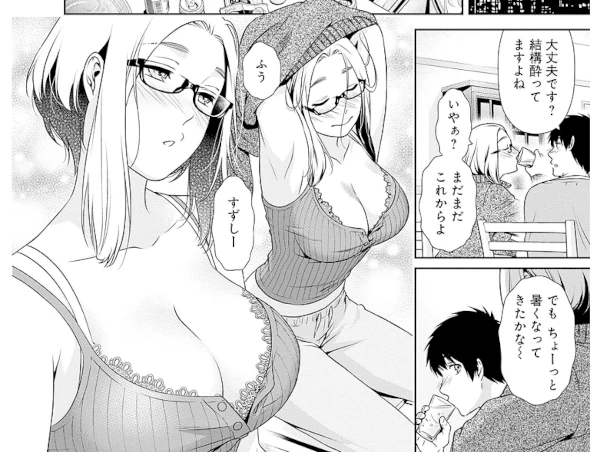
As you might expect from a shared-living setup, the story includes plenty of accidental run-ins with the women in sexy or compromising situations—so-called “lucky pervert” fan-service scenes.
That said, while it may sound like a heavily erotic harem comedy (and it certainly contains those elements), the core narrative is surprisingly sincere: a protagonist who lost his parents in childhood striving to build the “happy family” he never had.
This blend of playful ecchi comedy and heartfelt emotional storytelling gives the series its multifaceted appeal.
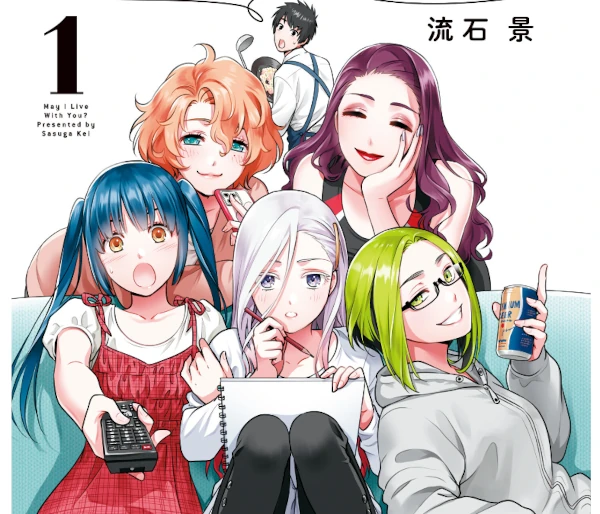
Why this manga is suitable for learning Japanese
This manga is not only entertaining but also highly recommended for Japanese learners for several reasons.
A High Ratio of Polite Speech
Hiromi has a modest, reserved personality and tends to speak to those around him using polite language and keigo. This naturally raises the overall ratio of polite dialogue in the manga, making it approachable and useful even for beginner Japanese learners.
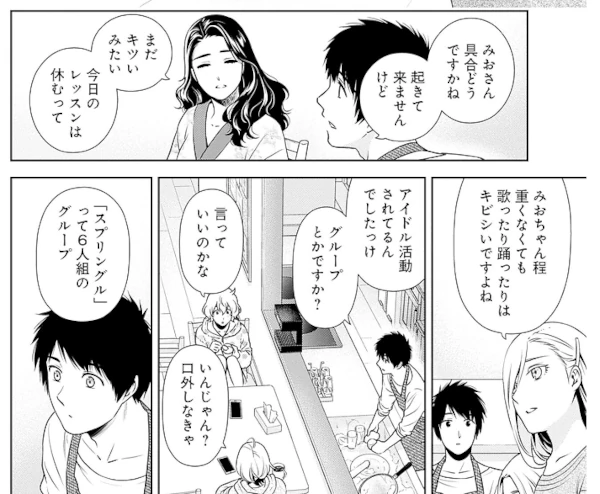
Japanese Across Diverse Situations
Hiromi is unemployed, while the women he lives with come from a wide range of professions and backgrounds—a fine arts student, an idol, a systems engineer, a pole dancer, and more. Because different characters take the spotlight in different chapters, readers are exposed to Japanese used in many everyday and professional contexts within a single work.
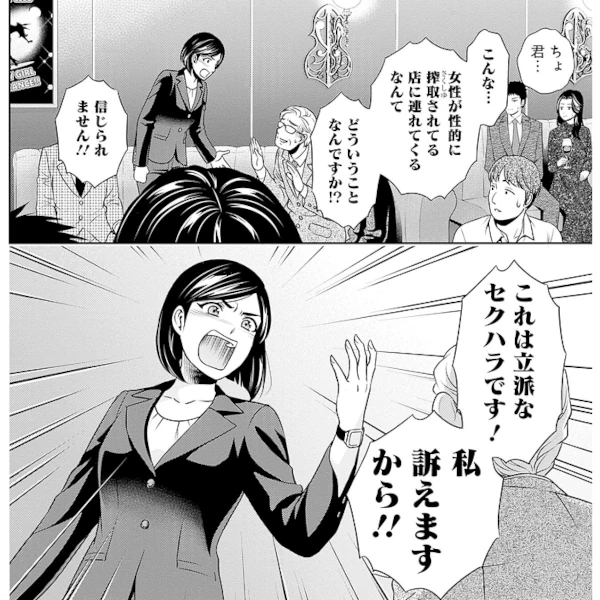
Culture Spotlight
Share Houses in Japan: Between Pop Culture Fantasy and Everyday Reality日本におけるシェアハウス
In the manga introduced this time, the male protagonist suddenly begins living together with five young, attractive women. While this setup feels distinctly fictional, it also reflects the growing visibility of share house culture in modern Japan. For Japanese learners, understanding the gap between fantasy and reality here offers useful cultural insight.
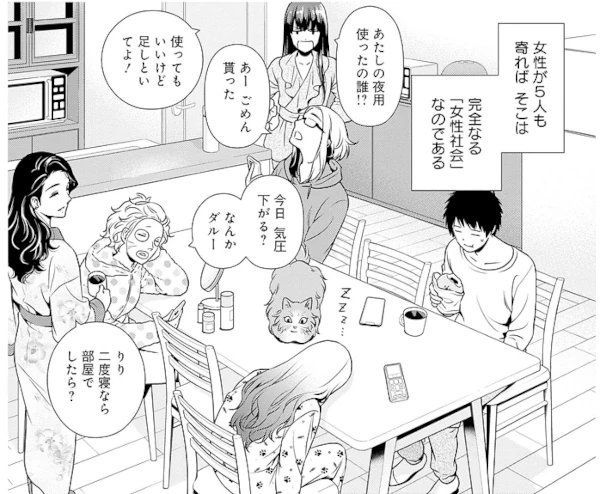
From Taboo to Trend: How Share Houses Emerged
Historically, Japanese society held strongly conservative views about cohabitation. Living together before marriage—especially between unmarried men and women—was widely considered improper.
However, from the 2000s onward, attitudes began to shift. Western lifestyle influences, changing economic conditions, and urban housing realities all contributed to the gradual spread of shared living arrangements.
Pop culture also played a role. Reality-style TV shows depicting young men and women living together—most famously Terrace House—helped normalize and popularize the image of stylish communal living mixed with romance.
As a result, the idea of the “share house” became culturally visible and aspirational, especially among younger generations.
Popular Image vs. Lived Reality
Despite this visibility, the reality in 2026 is that most people in Japan have never experienced house sharing.
In practice, share houses tend to be inhabited by a relatively small demographic—often socially outgoing individuals comfortable interacting with strangers and the opposite sex in close quarters.
This reflects broader social labels sometimes described as extrovert (“yō-kya”:陽キャ) vs. introvert (“in-kya”:陰キャ) culture: not everyone feels suited to communal living, especially in a society that traditionally values privacy, personal boundaries, and social harmony.
Fiction Was There First
Interestingly, fiction explored mixed-gender cohabitation long before real share houses became common.
For decades, manga, anime, and TV dramas featured classic setups where an unmarried man and woman end up living together due to unusual circumstances—financial trouble, housing shortages, or sheer coincidence.
In that sense, modern share house culture can feel like a real-world echo of long-standing fictional wish-fulfillment: a space where romance, tension, and emotional intimacy naturally unfold.
Why the Gap Still Exists
So why hasn’t reality caught up with fiction?
Several factors remain:
- Social expectations around modesty and propriety
- Concerns about privacy and interpersonal conflict
- Financial and housing contract barriers
- Lingering stigma around unmarried cohabitation
Even as attitudes soften, these structural and cultural constraints make share housing less widespread than its media image suggests.
The Gap Between Visibility and Reality
Share house residents in Japan tend to cluster within specific demographics:
- People in their 20s–30s
- Those who moved to Tokyo or other major cities
- Creators and IT workers
- International students
- Returnees from working holidays abroad
As a result, share houses are highly visible in media, social networks, and fiction—yet unfamiliar to the majority of the population.
Put simply, in Japan today:
Many people know what share houses are— but very few have actually lived in one.
This gap between cultural visibility and real-life experience is a key point for learners seeking to understand modern Japanese lifestyles.
What This Means for Learners
For learners of Japanese, share house stories offer more than romantic comedy.
They reflect:
- Changing views on relationships and independence
- The influence of global culture on Japanese lifestyles
- The tension between social norms and personal desire
Understanding this context helps explain why such settings feel both modern and slightly fantastical at the same time.
In short, the share house in Japanese media is not just a housing arrangement—it’s a cultural symbol, balancing aspiration, romance, and the slow evolution of social values.
A Little Warning
Slightly Mature Content
The manga does include a fair number of “lucky pervert” moments and scenes with sexual undertones—part of its entertainment appeal. Readers who are uncomfortable with suggestive fan service may want to keep this in mind.
Work Information
Issho ni kurashite iidesuka?(一緒に暮らしていいですか?)
Author: Sasuga Kei
Publisher: SHUEISHA
Amount of text: moderate
Challenge level: ★★
Latest volume : Vol.7(Jan.2026 / Ongoing)
Here’s a safe and convenient way to purchase Japanese manga.
This Blog’s ConceptIn this blog, we are introducing manga that are not only highly captivating but also ideal for Japanese language learners. Studying Japanese through manga is both fun and effective. Manga allows you to understand the subtleties of keigo (honorifics), teineigo (polite speech), and casual conversation in Japanese. We hope you find works that match your interests and use them to enhance your Japanese learning journey.