
This time, we’re introducing Betsuma Romance Short Story Collection Vol. 1: Never Forget This First Love—a great manga for learning both polite and casual Japanese through heartfelt teenage stories.
Work Information
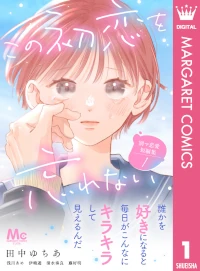
Betsuma Renai Tanpenshu (別マ恋愛短編集 1 ―この初恋を忘れない―)
Author: Tanaka Yuchia etc
Publisher: SHUEISHA
Amount of text: moderate
Challenge level: ★★
Latest volume : Vol.2(Jan.2024 / Completed)
Story overview
[The timeless thrill of first love] Sora enrolls in the same high school just to follow her beloved upperclassman, Akio. But as graduation approaches, he won’t even tell her where he plans to go next…? (“Goodbye Stardust” by Yuchia Tanaka)
This volume features five heart-fluttering first love stories that will stay with you forever. ★Included works★ “Goodbye Stardust” (Yuchia Tanaka) / “A Glance Upward” (Yu Ijima) / “Blooming Solo Trip” (Sora Shimizu) / “Youth, and Then” (Akira Fujiyoshi) / “The One That Got Away Was Tanaka” (Ame Asakawa)
The Appeal of This Manga
Bessatsu Margaret—often called Betsuma—is a long-running shōjo manga magazine with over 60 years of history, known for producing iconic works such as Hot Road, Kimi ni Todoke, and Ao Haru Ride.
This anthology collects debut works by new artists that were originally published as bonus booklet inserts in the magazine. Each story is characterized by the fresh, youthful sensitivity unique to newcomers, beautifully capturing the sparkling emotions of adolescence.
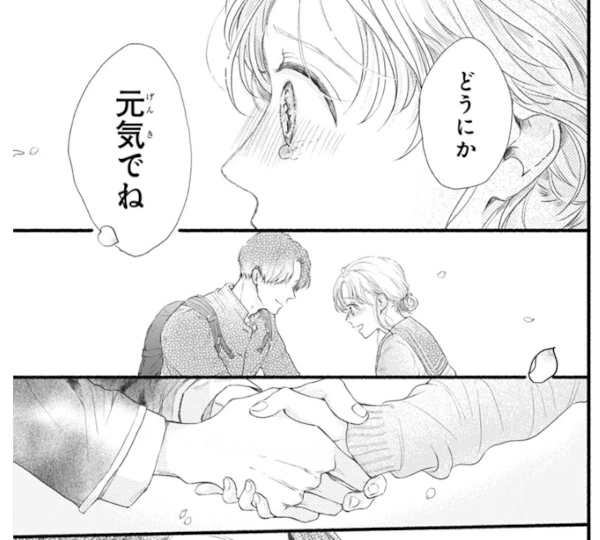
The opening story, “Goodbye Stardust” by Yuchia Tanaka, follows a high school girl who has been in love with her senior since middle school. As his graduation approaches, she struggles with how to come to terms with her feelings.
Will she be able to confess her love—or will it remain unspoken? The story offers a heart-pounding and emotional experience.
The other four stories each have their own unique charm, making the collection enjoyable from beginning to end.
Why this manga is suitable for learning Japanese
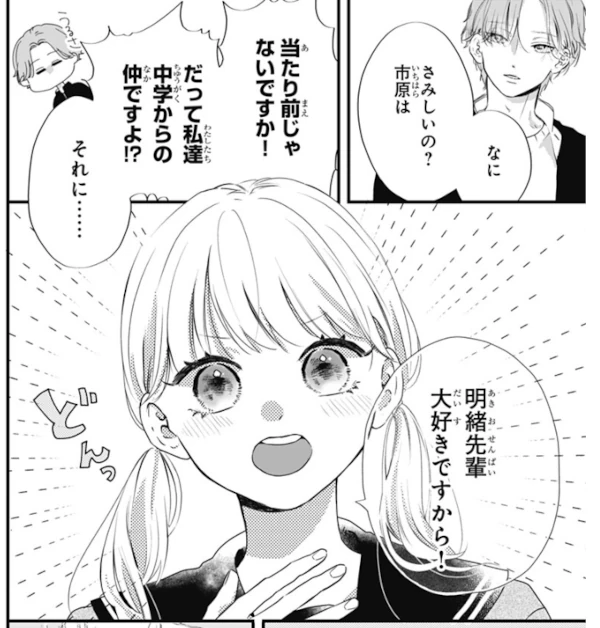
This manga is not only entertaining but also highly recommended for Japanese learners for several reasons.
Straightforward Polite Speech Used by High School Students
In the opening story, Sora, a second-year high school student, speaks to her admired senior using simple and natural polite Japanese (teineigo).
Her sincere teenage feelings are expressed through polite language, and since the text is not too dense, it’s a great choice for beginner learners of Japanese.
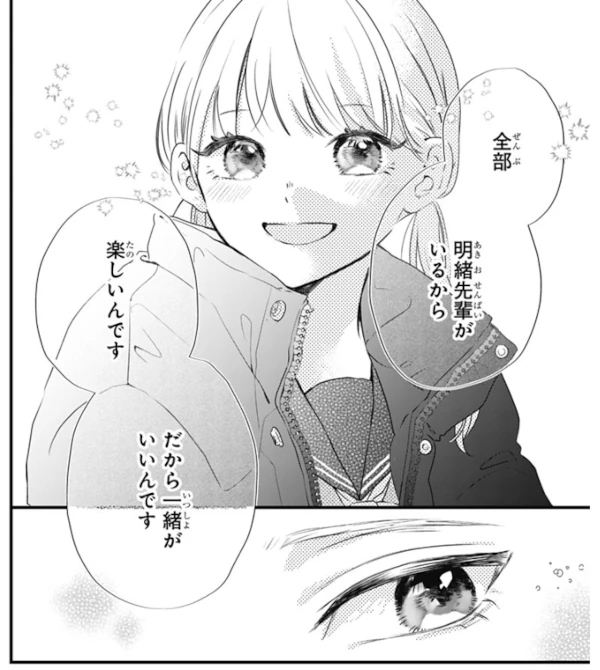
Natural Conversations Between High School Students
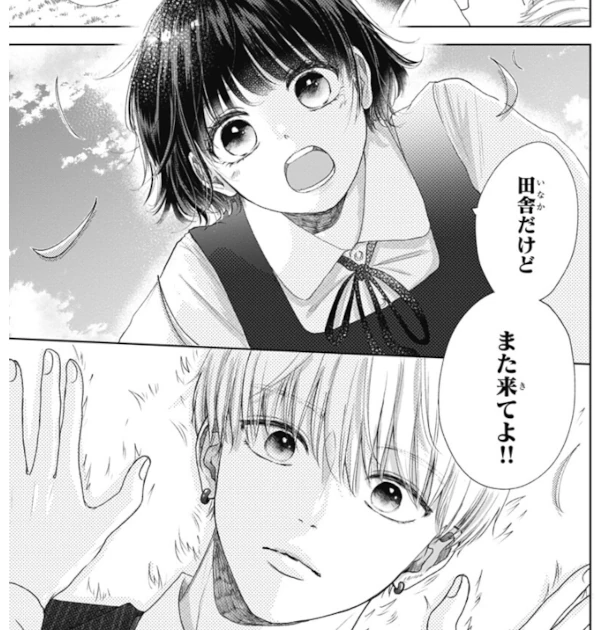
Out of the five stories, two include polite speech, while the remaining three focus on casual conversations between classmates.
This single volume allows learners to experience a range of everyday conversational styles used by Japanese high school students.
Culture Spotlight
The Second Button: A Timeless Symbol of First Love in Japanese School Culture制服の第二ボタン
In a scene from a romance manga, a girl nervously asks the boy she likes: 「第二ボタン、もらってもいい?」 “Can I have your second button?”
This small moment carries a surprisingly deep cultural meaning in Japan—and it’s something every learner of Japanese pop culture should know.
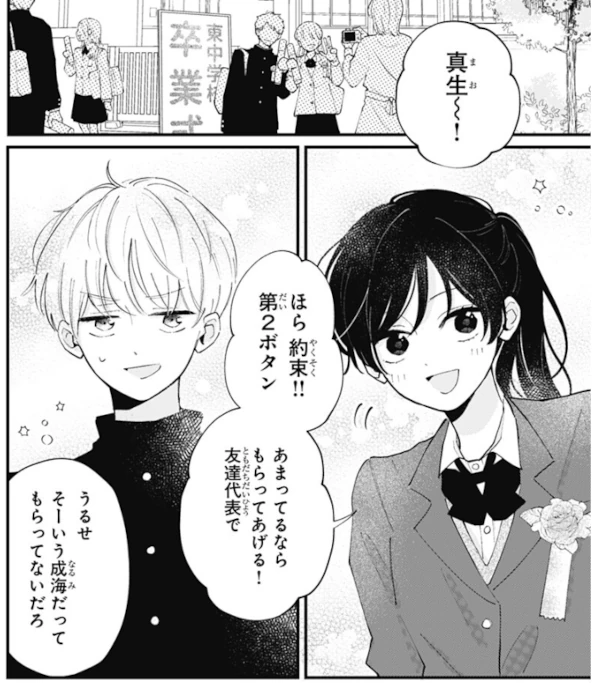
What Is the “Second Button” Tradition?
In Japanese schools, boys often wear uniforms with buttons running down the front. The second button from the top, closest to the heart, holds special symbolic value.
Traditionally, at graduation, a girl may ask the boy she likes for this second button. If he gives it to her, it can imply that his feelings are mutual.
In short, it represents:
- A confession of love
- A shared emotional moment at graduation
- A symbolic “giving of the heart”
Where Did This Tradition Come From?
The exact origin isn’t perfectly documented, but the custom is widely believed to date back to the early Showa era (1920s–1940s).
One popular theory links it to the military:
- Japanese military uniforms also had front buttons
- Soldiers departing for war would give a button to a loved one as a keepsake
- The button closest to the heart naturally carried emotional significance
Over time, this idea was adapted into school culture, transforming a wartime gesture into a romantic tradition among students.
How It Spread Through Shōjo Manga and Pop Culture
From the early days of shōjo manga in the Showa period, the “second button” became a perfect dramatic device:
- It happens at graduation, a natural emotional climax
- It involves unspoken feelings finally surfacing
- It creates tension: will he give it or not?
Because of this, it appeared again and again in:
- Shōjo manga
- Pop songs
- School romance anime
- TV dramas
Over decades, it became a “classic scene” (定番シチュエーション)—instantly recognizable to Japanese audiences.
A Comparison: Valentine’s Day in Japan
This tradition is often compared to Valentine’s Day in Japan, but there are key differences:
Valentine’s Day
- Happens every year
- Girls give chocolates to boys
- Can be casual (friends, classmates, obligation chocolate)
Second Button
- Happens once—at graduation
- Usually directed toward one special person
- Carries a stronger sense of finality and sincerity
In other words, Valentine’s Day is about opportunity, while the second button is about closure and emotional resolution.
Why Has It Endured Across Generations?
Despite changes from the Showa to Heisei to Reiwa eras, this trope remains popular. Why?
Simplicity and Symbolism A single object—a button—represents complex emotions. This makes it easy to understand and emotionally powerful.
A Universal Theme: First Love The idea of unspoken feelings at the end of youth is timeless and relatable across generations.
The Power of “Almost Too Late” Timing Graduation creates a perfect narrative moment:
- Time is running out
- Feelings must be expressed now—or never
This “last chance” tension is a core element of romance storytelling.
- Cultural Love of Subtle Expression
Rather than direct confession, the act of giving (or not giving) the button allows for indirect emotional communication, which aligns well with Japanese communication styles.
What It Means for Learners of Japanese
Understanding the “second button” tradition helps you:
- Recognize a classic trope in manga and anime
- Better understand emotional nuance in Japanese storytelling
- See how objects and actions can carry meaning beyond words
So next time you see a graduation scene in a manga, pay attention— that small button might carry the entire story’s emotional weight.
A Little Warning
Purely Youth Romance Stories
All five stories focus on romantic experiences of teenage girls. Because of this, readers looking for complex storytelling, highly unique characters, or unexpected plot twists may find the content somewhat simple.
If you’re not interested in the fresh and innocent emotions of teenage romance, this collection may not be for you.
Work Information
Betsuma Renai Tanpenshu (別マ恋愛短編集 1 ―この初恋を忘れない―)
Author: Tanaka Yuchia etc
Publisher: SHUEISHA
Amount of text: moderate
Challenge level: ★★
Latest volume : Vol.2(Jan.2024 / Completed)
Here’s a safe and convenient way to purchase Japanese manga.
This Blog’s ConceptIn this blog, we are introducing manga that are not only highly captivating but also ideal for Japanese language learners. Studying Japanese through manga is both fun and effective. Manga allows you to understand the subtleties of keigo (honorifics), teineigo (polite speech), and casual conversation in Japanese. We hope you find works that match your interests and use them to enhance your Japanese learning journey.