This time, we’re introducing Manga no Tsukurikata—a Girls’ Love manga perfect for learning Japanese through everyday conversation and manga-related vocabulary.
Work Information
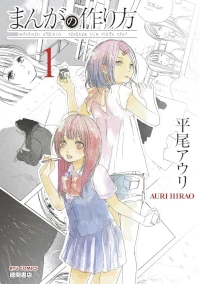
Manga no Tsukurikata(マンガの作り方)
Author: Hirao Auri
Publisher: TOKUMASHOTEN
Amount of text: moderate
Challenge level: ★★
Latest volume : Vol.8(May.2014/ Completed)
Story overview
Kawaguchi made his manga debut at just 13, but his career never really took off. Now 19, he is trying to make a fresh start as a manga artist.
Morishita is a popular manga artist working under the pen name Sachi. She has fallen deeply in love with her senior, Kawaguchi.
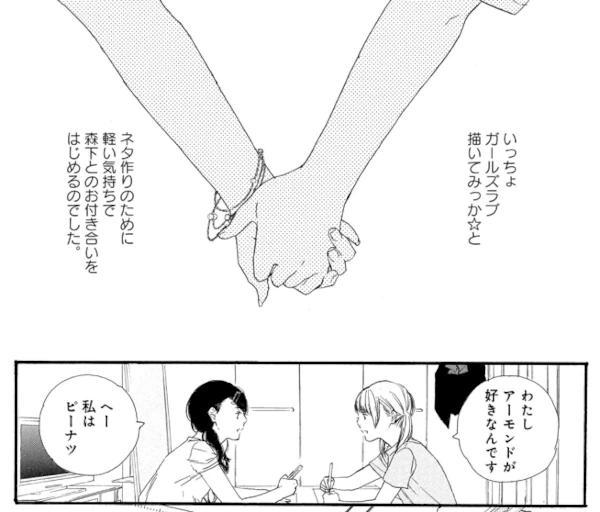
Kawaguchi, however, starts dating her for a rather impure reason: “Girls’ love is popular right now, so maybe this could give me an idea for a manga…” But where will their unusual relationship lead?
The Appeal of This Manga
This is the debut manga by Auri Hirao, the creator of the popular manga If My Favorite Pop Idol Made It to the Budokan, I Would Die, which was later adapted into both an anime and a live-action drama.
While If My Favorite Pop Idol Made It to the Budokan, I Would Die is arguably the more polished work as entertainment, How to Make Manga has a unique charm of its own.
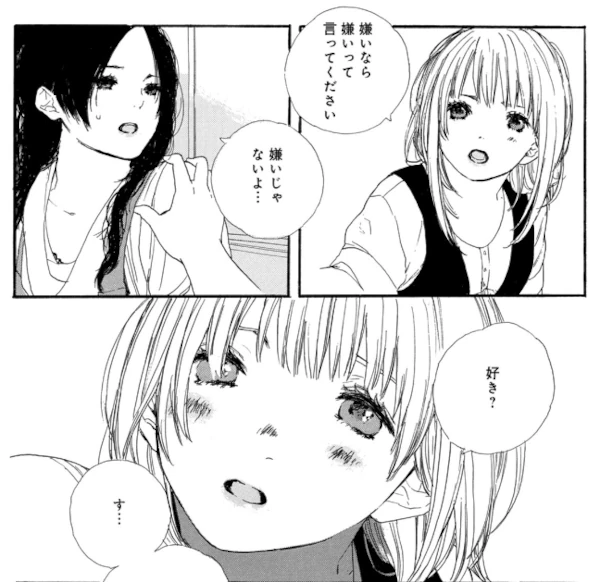
The characters are young, their romance is strange and uncertain, and none of them are fully mature in their own way. These qualities overlap with the youthful inexperience of the author herself at the beginning of her career, creating an indescribable atmosphere that is both bittersweet and strangely endearing.
The distinctive pauses and pacing that would become a hallmark of Hirao’s work are already on full display in this debut. The result is a quirky reading experience that can become surprisingly addictive.
Why this manga is suitable for learning Japanese
This manga is not only entertaining but also highly recommended for Japanese learners for several reasons.
Polite Japanese Between Juniors and Seniors
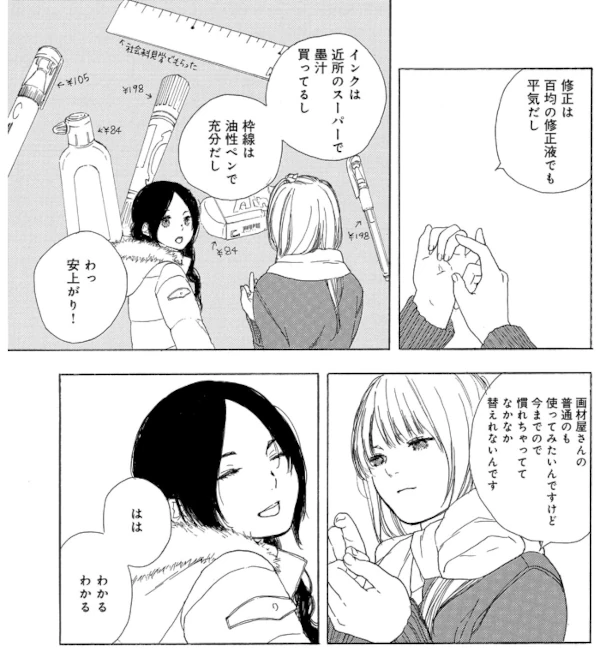
Morishita always speaks politely to Kawaguchi, who is both older than her and her senior at their part-time job. This gives learners a chance to experience the kind of natural, everyday polite Japanese used by a teenage girl when speaking to a senior.
Everyday Conversation and Manga-Related Vocabulary
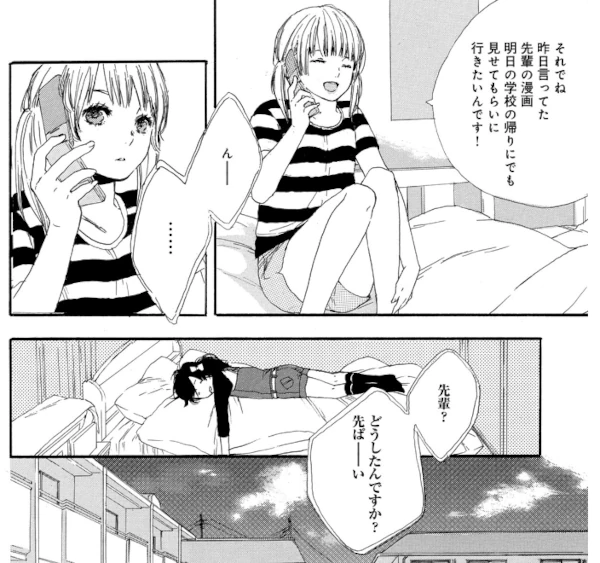
The manga contains plenty of dialogue and very little abstract or explanatory prose, making it relatively accessible even for beginner Japanese learners. Since the two main characters are manga artists, readers will also encounter plenty of vocabulary and conversations related to manga, drawing, and the life of a manga artist.
Culture Spotlight
Half a Joke, Half a Confession: The Japanese Romance of もらってくれますか?(お嫁さんに)もらってくれますか?
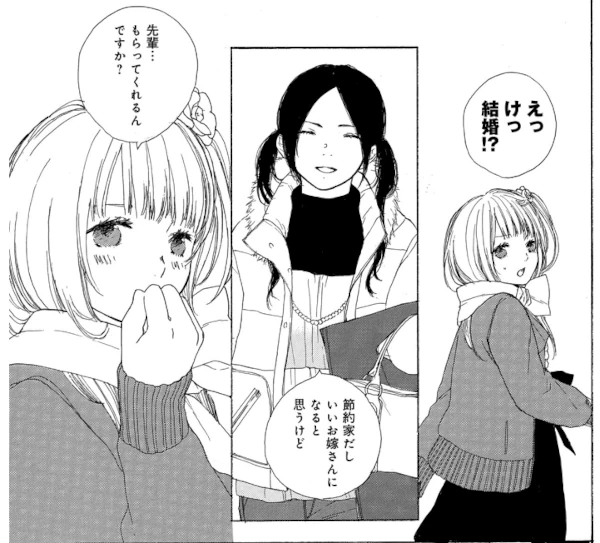
In Manga no Tsukurikata, Morishita is delighted when her beloved senior tells her that she would make a good wife. She responds:
「もらってくれるんですか?(もらってくれますか?)」 “Would you take me?” / “Would you marry me?”
At first glance, this may sound like a simple way of asking someone to marry you. But もらってくれる carries a much more nuanced feeling. It can sound slightly old-fashioned, modest, playful, and even teasing—while still expressing genuine romantic feelings underneath. For Japanese learners, it is a fascinating example of how a seemingly simple phrase can carry a lot of cultural and emotional nuance.
From 「もらう」 to “Would You Take Me?”
The verb もらう (morau) normally means “to receive” or “to get something from someone.” But in expressions involving marriage, もらう can take on a special meaning: to take someone as a wife.
For example:
「彼女をもらってください。」 “Please take her as your wife.”
This way of speaking reflects an older image of marriage in which a woman is metaphorically “given” or “taken” into another family.
Today, もらってください can sound somewhat old-fashioned or theatrical when used literally for marriage. But that is precisely what makes 「もらってくれますか?」 interesting. Rather than directly saying:
「私と結婚してくれますか?」 “Will you marry me?”
Morishita says something softer and more indirect: “Would you take me?”
Modest, Playful, and Just a Little Teasing
The ending 〜てくれますか is also important. It turns the statement into a polite request: “Would you do that for me?”
So 「もらってくれますか?」 has the feeling of:
“Would you… take me?” “Would you take me as your wife?”
There is a certain humility and modesty in the wording. Rather than confidently declaring “Marry me!”, Morishita leaves the decision to her senior: Would you be willing to take me?
At the same time, the phrase can sound playful and slightly coy, especially coming from a teenage girl. Because the expression is somewhat old-fashioned, it can feel like she is half-jokingly playing the role of a bride-to-be.
But there is another layer: the joke may not be entirely a joke.
That ambiguity creates much of the romantic charm of the scene. The listener can wonder: Is she teasing me—or is she actually asking? And the answer may be both.
Why Would a Teenage Girl Use Such an Old-Fashioned Phrase?
This is one reason the line works particularly well in manga.
A modern teenage girl would normally be much more likely to say something like:
「結婚してくれますか?」 “Will you marry me?”
Using 「もらってくれますか?」 instead gives Morishita’s words a deliberately old-fashioned, feminine, and romantic flavor.
Japanese fiction often uses expressions that are less common in ordinary modern conversation because they evoke particular images or personalities. Here, the slightly dated wording makes the confession feel almost like something from an old romantic story.
And because Morishita is young, the contrast can make the line feel cute and unexpectedly bold at the same time. She is not simply using formal language; she is choosing a particular style of speaking to express her feelings.
What It Means for Japanese Learners
「もらってくれますか?」 is a good example of why translating Japanese word-for-word is not always enough.
The literal idea is something like “Will you receive/take me?”, but in a romantic context it can mean “Would you marry me?” The expression also carries shades of modesty, femininity, old-fashioned romance, and playful indirectness.
For learners, the important point is that this is not a phrase to casually copy in everyday Japanese. Its effect depends heavily on context, relationship, age, personality, and tone. In modern conversation, 「結婚してくれますか?」 would be much more straightforward.
But when you encounter 「もらってくれる?」 or 「もらってくれますか?」 in a manga, novel, drama, or other fictional setting, recognizing this older romantic expression can reveal something that a simple dictionary translation misses: the speaker may be joking, being coy, and expressing genuine affection all at once.
A Little Warning
It’s a Girls’ Love Manga
There are no particularly explicit or intense romantic scenes, but the manga is a Girls’ Love (yuri) work. Readers who are uncomfortable with the genre may want to keep that in mind.
Work Information
Manga no Tsukurikata(マンガの作り方)
Author: Hirao Auri
Publisher: TOKUMASHOTEN
Amount of text: moderate
Challenge level: ★★
Latest volume : Vol.8(May.2014/ Completed)
Here’s a safe and convenient way to purchase Japanese manga.
This Blog’s ConceptIn this blog, we are introducing manga that are not only highly captivating but also ideal for Japanese language learners. Studying Japanese through manga is both fun and effective. Manga allows you to understand the subtleties of keigo (honorifics), teineigo (polite speech), and casual conversation in Japanese. We hope you find works that match your interests and use them to enhance your Japanese learning journey.