This time, we’re introducing My Favorite Maid Is the Kind of Woman Who Looks Good with a Cigarette—a manga perfect for learning gentle, everyday polite Japanese through a sweet and laid-back romance.
Work Information

Akogare no Meidosan ha Tabako ga niau(憧れのメイドさんはタバコが似合う)
Author: Shimamizu Eke
Publisher: SQUARE ENIX
Amount of text: moderate
Challenge level: ★★
Latest volume : Vol.4(Jun.2026/ Completed)
Story overview
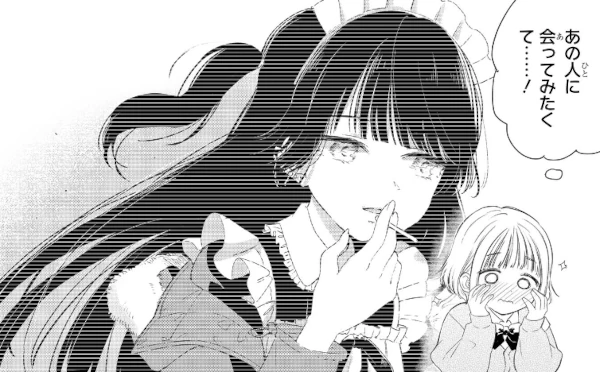
The woman I admired was a maid who looked effortlessly cool with a cigarette in her hand. Hijiri is a senior maid, and Suu is a rookie maid who looks up to her. Through Hijiri, Suu discovers a whole new world, and her heart is soon racing with excitement…!
A cigarette romance that took social media by storm, featuring a cast of maids with wonderfully distinct personalities! The first volume is here!
The Appeal of This Manga
Suu is a sheltered young lady who falls for the sight of a cool maid smoking a cigarette. Determined to get closer to her idol, she takes the plunge into the world of maid cafés.
As she grows closer to Hijiri, the manager of the café and the maid she admires, Suu discovers new sides of her—and finds herself captivated by every expression and gesture. Is it admiration, or is she falling in love?
Told from the perspective of the laid-back Suu, this manga unfolds in a gentle, heartwarming world. The cute maid outfits and the vividly drawn personalities of her fellow maids add to its charm.
Why this manga is suitable for learning Japanese
This manga is not only entertaining but also highly recommended for Japanese learners for several reasons.
Gentle, Soft-Spoken Polite Japanese
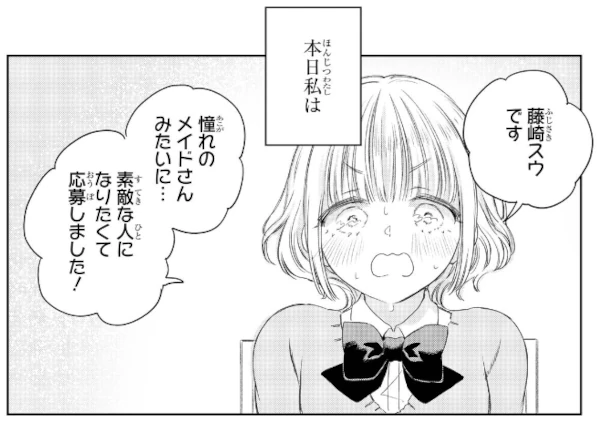
Suu was raised in an overprotective household, showered with perhaps a little too much affection by her parents. She always speaks politely to Hijiri, her admired senior and superior at work.
Suu’s gentle, unhurried personality comes through in her soft, polite way of speaking. Her language is particularly good for female Japanese learners looking for an example of a gentle, approachable style of polite Japanese.
Everyday Vocabulary and Furigana Throughout
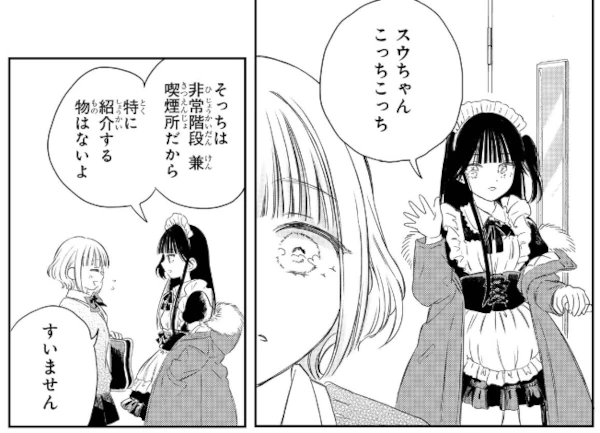
Most of the story takes place inside a maid café, so you won’t encounter many difficult concepts or specialized terms. You’ll pick up everyday vocabulary used in conversations at the café.
Every kanji in the manga comes with furigana, making it a good choice even for readers who find kanji readings challenging.
Culture Spotlight
The Many Meanings of “凸”: Understanding Japanese Internet Slang凸(とつ)
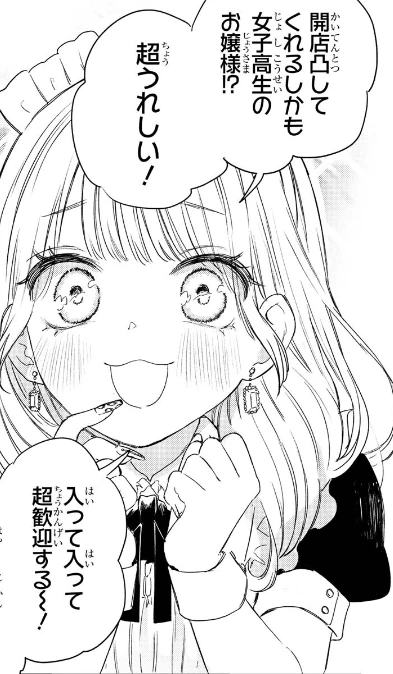
In My Favorite Maid Is the Kind of Woman Who Looks Good with a Cigarette, a maid gets excited when Suu, a high-school girl from a wealthy family, visits the maid café right as it opens. She exclaims:
「開店凸してくれるしかも女子高生のお嬢様!? 超うれしい!」 “An actual high-school young lady who comes rushing in right when we open?! I’m so happy!”
The key expression here is 開店凸 (かいてんとつ, kaiten totsu). The character 凸 is a particularly unusual-looking kanji, but in modern Japanese internet slang, it has developed several meanings that go far beyond its original sense. From showing up at a shop the moment it opens to powering up characters in mobile games, 凸 is a great example of how Japanese internet culture gives new life to an old character.
From a Strange-Looking Kanji to Internet Slang
The kanji 凸 is pronounced totsu in many compounds and means something like “protrusion” or “something that sticks out.” Its shape resembles a raised or projecting surface. Together with 凹 (ō), meaning a hollow or depression, it forms the familiar compound 凹凸 (ōtotsu), meaning “unevenness” or “bumps and hollows.”
Although 凸 is taught in Japanese schools, it is not a character that most people use frequently on its own in everyday writing. Its distinctive shape, however, makes it easy to recognize online. Internet users have adopted it in expressions that evoke the idea of moving forward, making contact, or directly approaching something or someone.
The meanings of these expressions depend heavily on context. Sometimes 凸 suggests physically showing up somewhere; in other contexts, it has become a specialized term with a meaning that is not immediately obvious from the kanji itself.
「開店凸」: Showing Up Right When a Shop Opens
Let’s return to the expression from the manga: 開店凸.
開店 (kaiten) means “opening for business,” while 凸 is associated with 突撃 (totsugeki), meaning “charge” or “突撃” — a direct, sometimes forceful approach. This connection gives 開店凸 its energetic slang feel: showing up at a shop right when it opens, often to be among the first customers.
In the manga, Suu visits the maid café as soon as it opens, delighting the maid with her unexpected arrival. The expression could also describe visiting a popular café at opening time or rushing to a store for limited-edition merchandise.
Unlike the more neutral 開店と同時に行く (“go as soon as the shop opens”), 開店凸 sounds punchier and more like internet slang.
「凸」 in Mobile Games: Breaking Through to the Next Level
In Japanese mobile games, 凸 is used to describe character upgrades, often achieved by obtaining duplicate copies of a character or item.
For example, 1凸 (ichi-totsu) and 2凸 (ni-totsu) refer to one or two upgrade steps, while 完凸 (kantotsu) means reaching the maximum upgrade level. The exact mechanics vary by game.
You might hear:
- 「このキャラ、1凸でかなり強くなるよ。」 — “This character gets a lot stronger with one upgrade.”
- 「完凸したいけど、石が足りない。」 — “I want to fully upgrade this character, but I don’t have enough premium currency.”
Here, 石 (ishi, “stones”) is shorthand for in-game currency. These terms are compact gaming slang, letting players discuss upgrade levels without lengthy explanations.
Unlike 開店凸, this usage refers to game progression, showing how 凸 has developed different specialized meanings in different online communities.
「電凸」 and Other Ways to Use 凸
電凸 (dentotsu) is short for 電話突撃 (denwa totsugeki), literally “phone attack.” It means directly calling a person or organization to ask questions, complain, or confront them about an issue. The term often appears in online controversies and can carry an aggressive tone.
「問題について、会社に電凸したらしい。」 “Apparently, they called the company directly to confront them about the issue.”
Other expressions include 凸る (totsuru), meaning to contact or approach someone directly, sometimes by phone or in person, and 凸待ち (totsumachi), used on livestreams when a broadcaster waits for viewers to call in or join.
These expressions share the idea of taking direct action—making contact rather than simply discussing someone online.
What 「凸」 Means for Japanese Learners
For Japanese learners, 凸 is a useful reminder that knowing a kanji’s basic meaning does not necessarily tell you how it is used in modern slang.
The same character can appear in several expressions with quite different meanings:
- 開店凸 — showing up right when a shop opens
- 1凸 / 完凸 — reaching one or the maximum upgrade level in a game
- 電凸 — directly calling someone or an organization, often to question or confront them
- 凸る — approaching or contacting someone directly
- 凸待ち — waiting for someone to call in or join a broadcast
These meanings are best learned as part of their respective contexts: manga and everyday internet slang, mobile gaming, or online controversies and livestreams.
You don’t need to start using these expressions yourself to benefit from understanding them. Recognizing 凸 will help you make sense of Japanese social media posts, gaming discussions, livestreams, and manga dialogue—and give you a glimpse into the creative ways Japanese speakers adapt written characters to the language of the internet.
A Little Warning
Yuri-Like Elements
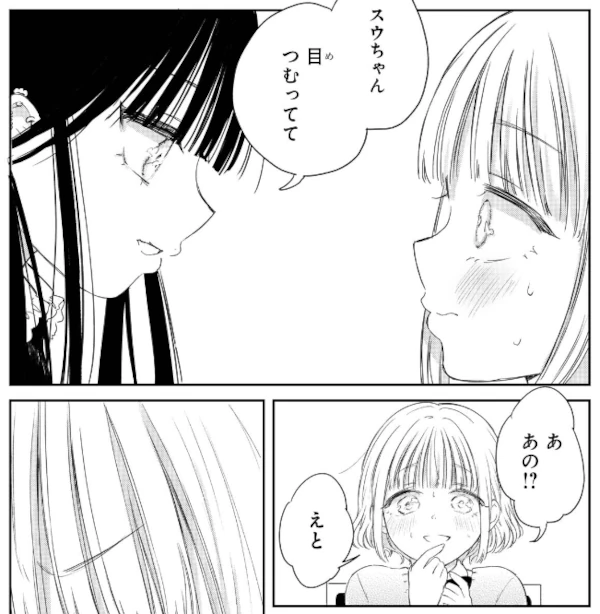
Although this isn’t explicitly a yuri manga, Suu’s feelings for Hijiri are left open to interpretation: is she simply an admirer, or is there something more romantic behind her affection?
Readers who aren’t comfortable with this kind of ambiguous, potentially romantic relationship between female characters may want to keep that in mind.
Work Information
Akogare no Meidosan ha Tabako ga niau(憧れのメイドさんはタバコが似合う)
Author: Shimamizu Eke
Publisher: SQUARE ENIX
Amount of text: moderate
Challenge level: ★★
Latest volume : Vol.4(Jun.2026/ Completed)
Here’s a safe and convenient way to purchase Japanese manga.
This Blog’s ConceptIn this blog, we are introducing manga that are not only highly captivating but also ideal for Japanese language learners. Studying Japanese through manga is both fun and effective. Manga allows you to understand the subtleties of keigo (honorifics), teineigo (polite speech), and casual conversation in Japanese. We hope you find works that match your interests and use them to enhance your Japanese learning journey.