
This time, we’re introducing The Saintly Life in Another World of a Reincarnated Great Saint—a manga perfect for learning gentle, everyday polite Japanese through a relaxing fantasy adventure.
Work Information
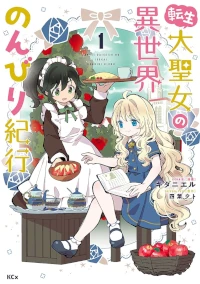
Tensei Daiseijo no Isekai Nonbiri Kikou(転生大聖女の異世界のんびり紀行)
Author: Kidaniel/YotsubaYuto
Publisher: KODANSHA
Amount of text: moderate
Challenge level: ★★
Latest volume : Vol.12(Aug.2026 / Ongoing)
Story overview
Hirune, an overworked employee at a notoriously exploitative company, is reincarnated in another world with a goddess’s blessing.
She begins her new life as a blonde girl named Hirune. But after the exhausting work culture of her previous life, she has no desire to work herself to the bone again. Instead, she decides to become a Great Saint and enjoy a leisurely life!
And so begins the legend of a sleepy Great Saint who takes life at her own pace!
The Appeal of This Manga
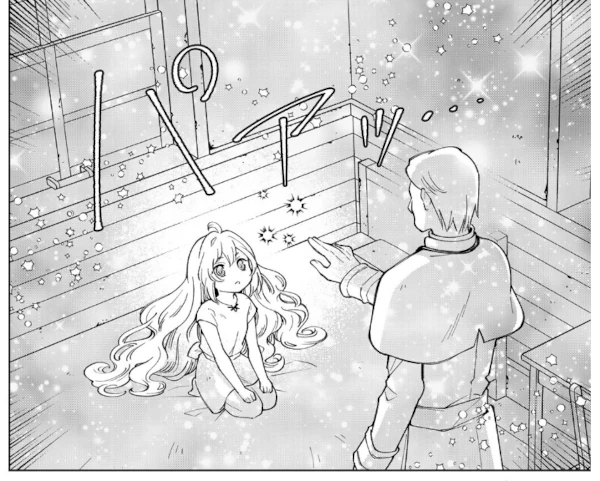
Reborn in another world, Hirune sets out on the path to becoming a saint. Thanks to her hidden abilities, she gradually brings happiness to the people around her.
Hirune is a laid-back heroine who always seems sleepy and rarely feels motivated to do much. Her relaxed daily life fits perfectly with the manga’s soft, gentle artwork, offering readers a wonderfully soothing escape.
Why this manga is suitable for learning Japanese
This manga is not only entertaining but also highly recommended for Japanese learners for several reasons.
Saints Speak Politely
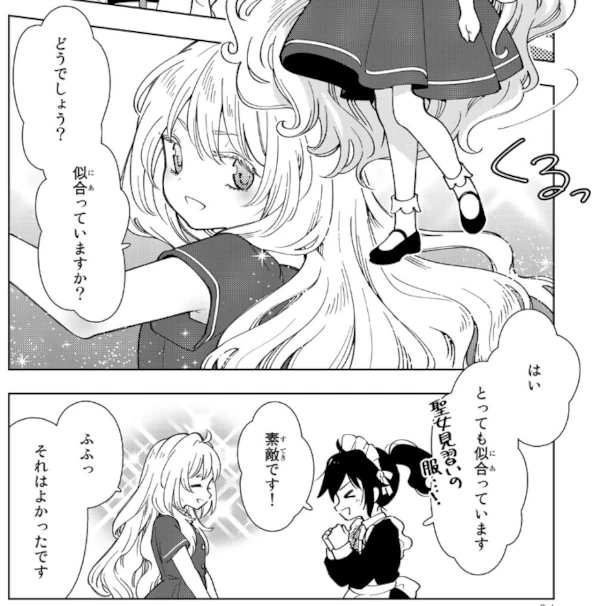
Hirune, a trainee saint, and Jeanne, her maid, consistently use polite Japanese when speaking to each other. Since both main characters use this style, polite language appears frequently throughout the manga.
Their conversations provide plenty of examples of gentle, relaxed, and approachable polite Japanese.
Furigana Throughout and Everyday Vocabulary
Every kanji in the manga comes with furigana, so readers can check pronunciations without having to look up unfamiliar characters individually.
Although the story takes place in a fantasy world, it features plenty of everyday scenes and conversations. This makes it a useful source of vocabulary that learners can also apply to real-life situations.
Culture Spotlight
More Than Just “Black”: Exploring ブラック in Modern Japaneseブラック(ブラック企業)
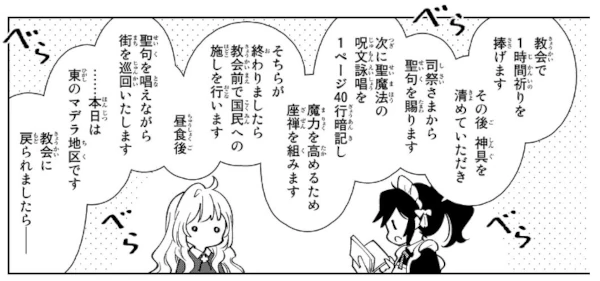
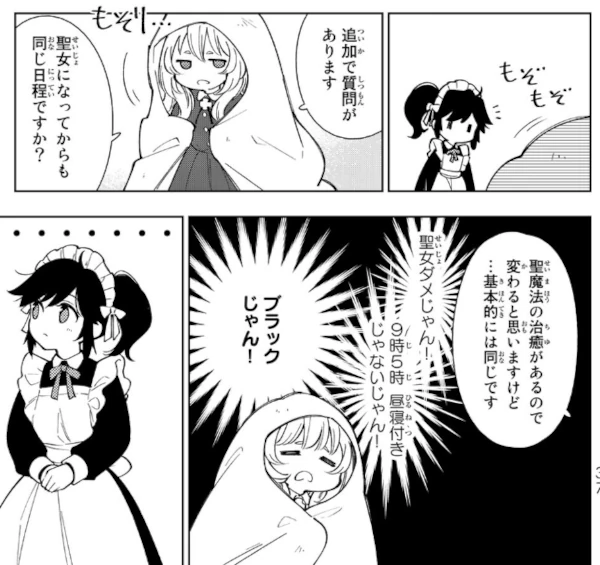
In the manga, Hirune is reincarnated into another world and thinks becoming a trainee saint sounds like an easy job. But when she discovers that her schedule is packed and the work is far busier than she expected, she blurts out: 「ブラックじゃん」—“That’s so exploitative!” or “That’s a terrible work environment!”
In Japan, ブラック (burakku), meaning “black,” is used in a variety of expressions related to negative, suspicious, or exploitative situations. One of the best-known examples is ブラック企業 (burakku kigyō), a term for companies with harsh working conditions. Over time, people began using ブラック on its own to express similar ideas, even without explicitly mentioning a company. Let’s explore how this color-related word developed its modern meanings and how to recognize it in everyday Japanese.
From ブラック企業 to Just ブラック
The expression ブラック企業 became widely recognized in Japan in the late 1990s and early 2000s, referring to companies that subject employees to exploitative working conditions. These might include excessive overtime, unpaid wages, unreasonable workloads, or workplace harassment.
For example:
「あの会社、ブラック企業らしいよ。」 — “I heard that company has terrible working conditions.”
「毎日終電まで働いてるの? ブラックだね。」 — “You work until the last train every day? That sounds awful.”
In casual conversation, speakers may shorten ブラック企業 to simply ブラック when the context makes the meaning clear. In the manga, 「ブラックじゃん」 uses this shortened form to express the realization that the trainee saint’s job is far from easy.
The ending じゃん is a casual expression similar to “That’s so…” or “Isn’t it…?” depending on context. Here, Hirune uses it to react to the unpleasant discovery, giving the line a conversational, slightly exasperated tone.
Importantly, ブラック does not always refer to employment. Its meaning depends on the situation, so learners should pay attention to the words and circumstances surrounding it.
Blacklists, Black Money, and Black Humor
The negative associations of black are not unique to Japanese. English also uses “black” in expressions such as blacklist and black market. Japanese has adopted and developed similar expressions, although their meanings and everyday usage vary.
ブラックリスト (burakku risuto) —
“Blacklist.” A list of people, organizations, or items that are excluded, flagged, or treated as undesirable. For example, a person might be placed on a blacklist for repeatedly violating rules.ブラックマネー (burakku manē) —
“Black money.” Depending on the context, this can refer to money connected with illegal or concealed activities, such as undeclared income or illicit transactions. It is less of an everyday conversational term than ブラック企業.ブラックジョーク (burakku jōku) —
“Black humor” or “dark joke.” A joke that deals with grim, taboo, or disturbing subjects, often in a deliberately provocative way.
Notice that these expressions do not all mean the same thing. ブラック企業 describes exploitative employment conditions, while ブラックリスト concerns exclusion or suspicion, and ブラックジョーク refers to a particular style of humor.
For Japanese learners, the important lesson is that ブラック is not a word with one fixed negative meaning. It is part of a family of expressions whose meanings have to be learned individually.
White Companies, White Knights, and Other Contrasts
If ブラック can suggest something undesirable, what about ホワイト (howaito), meaning “white”? In some Japanese expressions, white functions as a contrasting term, but the relationship is not always straightforward.
The clearest example is ホワイト企業 (howaito kigyō), the counterpart to ブラック企業. It refers to a company with relatively good working conditions, such as reasonable working hours, fair treatment, and a healthy workplace culture.
For example:
- 「この会社は残業が少なくて、ホワイト企業だね。」 — “This company has little overtime. It’s a great place to work.”
However, not every expression containing ホワイト is the direct opposite of one containing ブラック. The meaning depends on the expression itself, and some terms are borrowed from English with specialized meanings.
When learning these expressions, it is useful to remember familiar pairs such as ブラック企業 and ホワイト企業, rather than assuming that black and white always form a simple opposite pair.
What These Expressions Mean for Japanese Learners
The expression 「ブラックじゃん」 is a useful example of how Japanese speakers compress cultural knowledge into a short, casual remark. Hirune does not need to say 「この仕事は労働環境が過酷だ」 (“The working conditions of this job are harsh”). By saying 「ブラックじゃん」, she conveys her disappointment in just a few words.
For learners, here are three practical points to remember:
Listen for context.
ブラック can refer to exploitative working conditions, suspicious activities, or dark humor, depending on the expression.Learn common combinations.
ブラック企業, ブラックリスト, ブラックジョーク, and ホワイト企業 each have their own established meanings.Pay attention to tone.
In casual speech, 「ブラックじゃん」 can sound like a spontaneous complaint or an incredulous reaction, rather than a formal assessment.
Once you recognize these patterns, you will be better equipped to understand Japanese conversations about work, business, and everyday frustrations. And if a supposedly easy job turns out to involve a completely packed schedule, you might find yourself thinking exactly what Hirune does: 「ブラックじゃん」!
A Little Warning
Watch Out for Fictional Speech Patterns
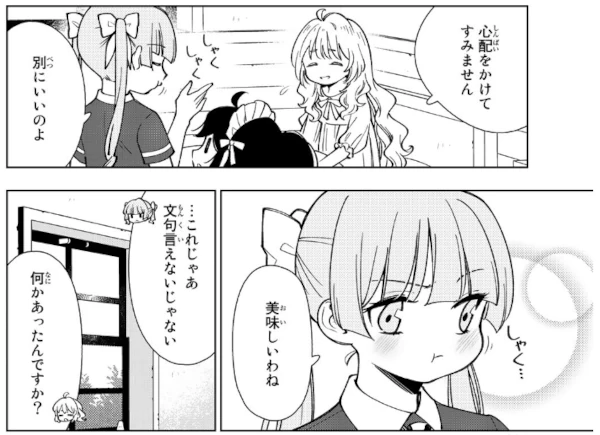
One of the main characters, Holly, has a tsundere personality and uses stereotypical fictional feminine endings such as 「〜だわ」 and 「〜わよ」.
These expressions are common in fictional portrayals of certain character types, but they are not typical of everyday modern Japanese conversation. Using them unironically in real life may earn you a few bemused smiles, so enjoy them as part of the character’s personality rather than copying them directly!
Work Information
Tensei Daiseijo no Isekai Nonbiri Kikou(転生大聖女の異世界のんびり紀行)
Author: Kidaniel/YotsubaYuto
Publisher: KODANSHA
Amount of text: moderate
Challenge level: ★★
Latest volume : Vol.12(Aug.2026 / Ongoing)
Here’s a safe and convenient way to purchase Japanese manga.
This Blog’s ConceptIn this blog, we are introducing manga that are not only highly captivating but also ideal for Japanese language learners. Studying Japanese through manga is both fun and effective. Manga allows you to understand the subtleties of keigo (honorifics), teineigo (polite speech), and casual conversation in Japanese. We hope you find works that match your interests and use them to enhance your Japanese learning journey.