This time, we’re introducing Ai da toka Fukushū da toka—a manga perfect for learning natural, everyday Japanese through a fast-paced body-swapping mystery.
Work Information
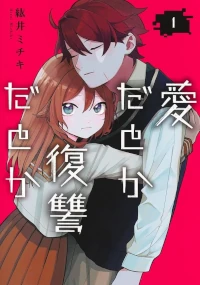
Ai datoka Fukushu datoka(愛だとか復讐だとか)
Author: Hiroi Michiki
Publisher: SHUEISHA
Amount of text: moderate
Challenge level: ★★
Latest volume : Vol.4(May.2026/ Completed)
Story overview
“One day, I woke up in the body of a girl I didn’t know.”
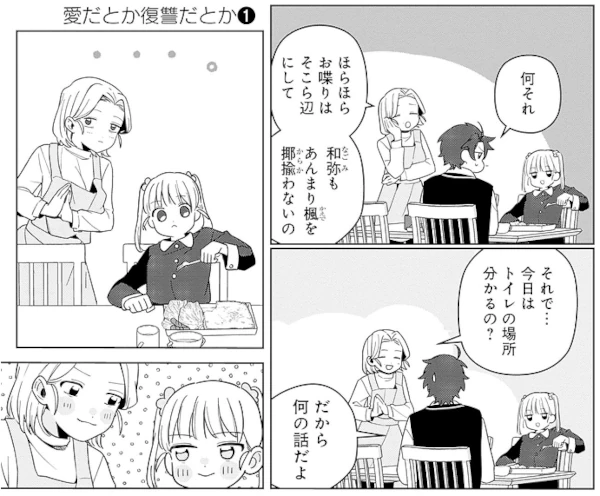
For Kaede Koshiba, an ordinary day begins with a strange sense that something is wrong. As his family and high school classmates tell him about events he has no memory of, he gradually realizes that he and a girl he has never met, Yuka Tsutsumi, are switching bodies every other day.
Just as Kaede and Yuka begin working together to figure out what is causing this strange phenomenon, his everyday life takes an unexpected turn…
The Appeal of This Manga
This light mystery combines a fresh, modern art style with intriguing supernatural elements. The story is easy to follow, and the characters are appealing in their own right.
With its fast-paced plot, you may find yourself finishing the first volume in no time. It’s an engaging read that will leave you eager to find out what happens next.
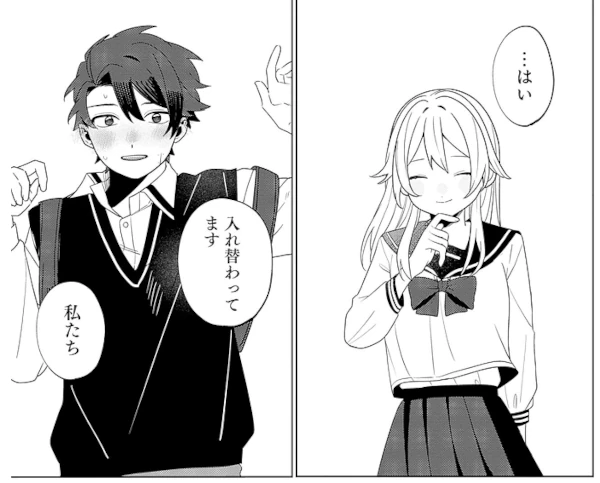
Why this manga is suitable for learning Japanese
This manga is not only entertaining but also highly recommended for Japanese learners for several reasons.
Natural, Everyday Dialogue
Although the story features plenty of fantastical situations, the conversations themselves feel grounded in everyday life. The characters also avoid exaggerated, fictional speech patterns, making their dialogue a useful reference for learning natural Japanese as it is actually spoken.
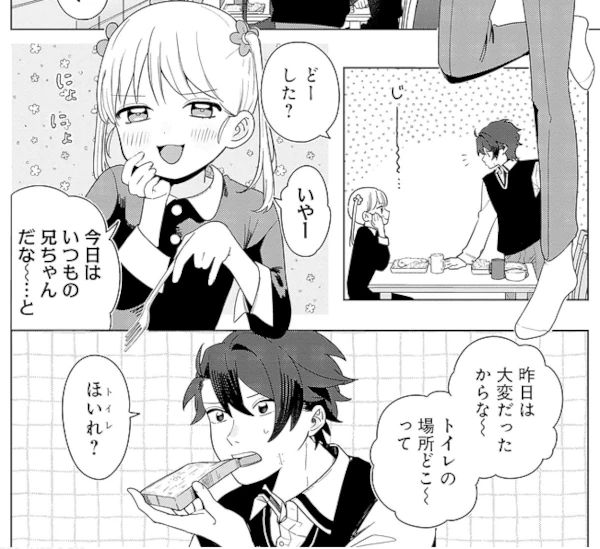
Easy to Read, with Relatively Little Text
The manga contains relatively little text overall, making it less demanding for beginner Japanese learners. Furigana (reading aids written in hiragana or katakana) are also provided for difficult kanji, helping readers work through the text with less difficulty.
Phrase Spotlight
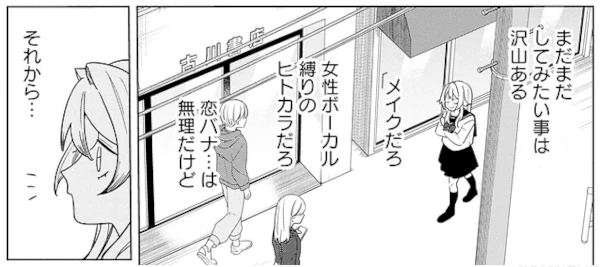
Hitokara and Beyond: How Japanese Abbreviations Become Everyday Wordsヒトカラ
In the manga, Kaede, who has unexpectedly switched bodies with a high school girl, comes up with a list of things he wants to try while he has the chance. One of them is 「女性ボーカル縛りのヒトカラ」—going to karaoke alone and singing only songs by female vocalists.
The word ヒトカラ (hitokara) is a shortened form of 一人カラオケ (hitori karaoke), meaning “going to karaoke alone.” Today, it is a familiar term in Japan, reflecting how karaoke has evolved from a group activity into something people can enjoy on their own. It also offers a great example of how Japanese abbreviations can become established everyday vocabulary.
From Group Entertainment to a Personal Hobby
Karaoke has long been a popular form of entertainment in Japan, but the spread of karaoke boxes (カラオケボックス) in the late 1980s and early 1990s transformed the way people enjoyed it. Unlike traditional karaoke venues, such as bars and snack bars, karaoke boxes offered private rooms where friends could sing together without worrying about other customers. They quickly became popular among younger people, including high school and university students.
For many people, karaoke was a social activity: friends gathered, took turns choosing songs, and enjoyed singing together. But the private-room format also made it easier to enjoy karaoke without an audience of strangers.
As karaoke became more accessible, people gradually began to enjoy it in different ways. Some wanted to practice singing without feeling self-conscious, while others simply wanted to sing their favorite songs at their own pace.
Going to karaoke alone became known as 一人カラオケ, and the shorter form ヒトカラ eventually became a widely recognized term. Rather than being limited to a group activity, karaoke had become a hobby that people could enjoy entirely on their own.
From 一人カラオケ to ヒトカラ: How Japanese Abbreviations Work
Japanese speakers frequently shorten longer expressions to make them easier and quicker to say. When an abbreviation catches on, it can become a word in its own right, understood without needing to know the original phrase.
In 一人カラオケ, 一人 (hitori) means “one person” or “alone,” while カラオケ (karaoke) means karaoke. The abbreviation ヒトカラ takes the beginning of 一人 and combines it with a shortened form of カラオケ.
Here are a few other familiar examples:
- スマホ (sumaho) — short for スマートフォン (sumātofon), meaning “smartphone.”
- リモコン (rimokon) — short for リモートコントロール (rimōto kontorōru), meaning “remote control.”
- コンビニ (konbini) — short for コンビニエンスストア (konbiniensu sutoa), meaning “convenience store.”
- ソロキャン (sorokyan) — short for ソロキャンプ (soro kyanpu), meaning “solo camping.”
These words illustrate how Japanese often favors compact expressions in everyday conversation. Once an abbreviation becomes familiar enough, speakers can use it naturally without thinking about the longer form.
For learners, recognizing these shortened words is especially useful because they appear frequently in casual conversation, advertising, social media, and manga.
What These Expressions Mean for Japanese Learners
ヒトカラ is a useful example of how language changes alongside everyday life. A familiar activity gained a new form, and a convenient abbreviation emerged to describe it. Today, the word can be used naturally in conversation without any need to explain what it means.
For Japanese learners, there are three key points to remember:
Learn abbreviations as complete vocabulary items.
Words such as ヒトカラ, スマホ, and コンビニ are often more useful in everyday conversation than their full forms.Pay attention to how words are combined.
Expressions such as 女性ボーカル縛りのヒトカラ show how speakers add details to an established term to describe a particular activity.Remember that doing something alone is not necessarily unusual.
In modern Japanese, expressions for solo activities are part of everyday vocabulary, reflecting the many ways people choose to spend their free time.
The next time you hear someone mention ヒトカラ, you will know that they are not talking about a special type of karaoke machine. They are simply heading to karaoke on their own—and enjoying the freedom to sing whatever they like!
A Little Warning
A Character Who Speaks Kansai Dialect
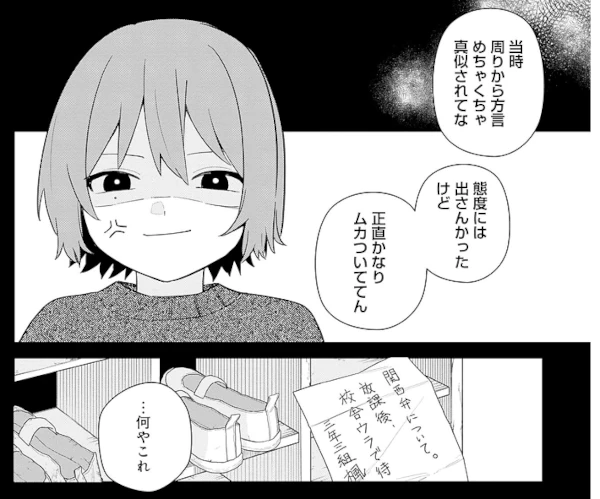
Yota, one of Kaede’s friends, speaks Kansai dialect. Since Kansai dialect uses sentence endings and expressions that differ from standard Japanese, beginners may find some of his dialogue a little challenging to understand.
Work Information
Ai datoka Fukushu datoka(愛だとか復讐だとか)<
Author: Hiroi Michiki
Publisher: SHUEISHA
Amount of text: moderate
Challenge level: ★★
Latest volume : Vol.4(May.2026/ Completed)
Here’s a safe and convenient way to purchase Japanese manga.
This Blog’s ConceptIn this blog, we are introducing manga that are not only highly captivating but also ideal for Japanese language learners. Studying Japanese through manga is both fun and effective. Manga allows you to understand the subtleties of keigo (honorifics), teineigo (polite speech), and casual conversation in Japanese. We hope you find works that match your interests and use them to enhance your Japanese learning journey.