
This time, we’re introducing Contract Sisters—a charming yuri romantic comedy for learning everyday Japanese and natural polite expressions.
Work Information
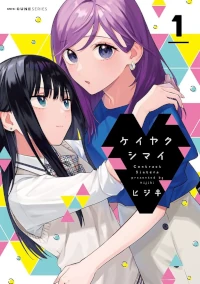
Contract Sisters(ケイヤクシマイ)
Author: HIJIKI
Publisher: KADOKAWA
Amount of text: moderate
Challenge level: ★★
Latest volume : Vol.6(Jun.2026/ Ongoing)
Story overview
A yuri romantic comedy about two women who enter into a sisterhood contract. Kasane Hayfuji’s greatest pleasure in life is visiting Aoyama, a woman who works at a family restaurant. One day, Kasane finds Aoyama standing alone in the rain and decides to help her.
To Kasane’s surprise, Aoyama suddenly proposes that they enter into a contract to become sisters. And so, an unexpected relationship begins…
The Appeal of This Manga
At first glance, Hayafuji Kasane appears to be a beautiful office lady. In reality, however, she’s a closeted yuri enthusiast. After falling in love at first sight with Aoyama Meguru, a waitress at a family restaurant she happened to visit, Kasane starts going there regularly. Before long, the two become familiar with each other—and somehow end up entering into a mysterious sisterhood contract.
Trying to hide her romantic feelings for Meguru, Kasane does her best to act like a proper older sister. Meanwhile, Meguru remains an enigma, with motives and behavior that are difficult to predict. Their exciting and sometimes bewildering life together is just getting started.
Although this manga belongs to the yuri genre, you don’t need to be particularly familiar with the genre to enjoy it. The story is lighthearted and easy to read, with very few sexually suggestive scenes. It could even be a good starting point for readers who are new to yuri manga.
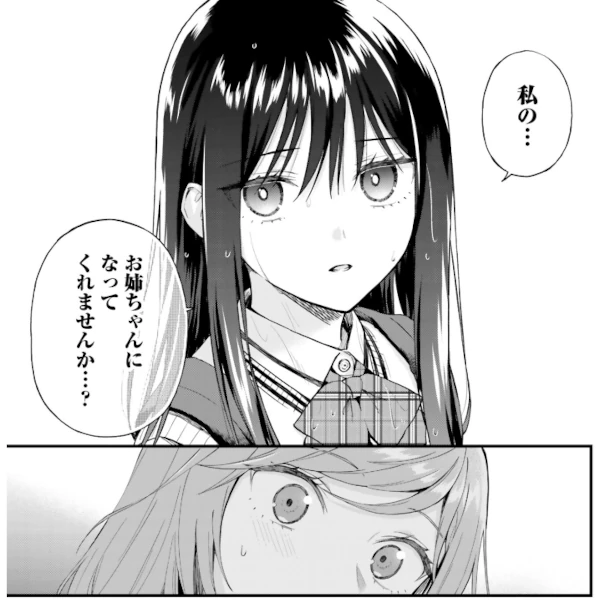
Why this manga is suitable for learning Japanese
This manga is not only entertaining but also highly recommended for Japanese learners for several reasons.
Polite Language When Speaking to Someone Older
When she’s not in her younger-sister role, Meguru uses polite Japanese when speaking to Kasane, who is ten years older than her.
As a high school student, Meguru provides plenty of examples of natural, standard polite speech used by younger people when talking to someone older. This makes the manga useful for learning how polite language works in everyday interactions between people of different ages.
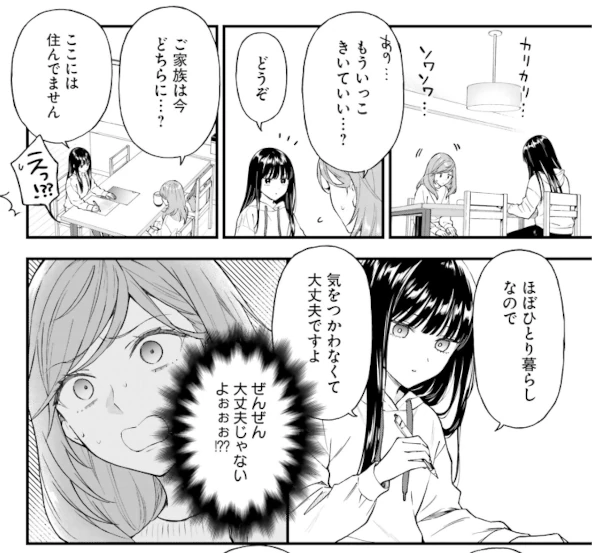
Everyday Conversations and Vocabulary
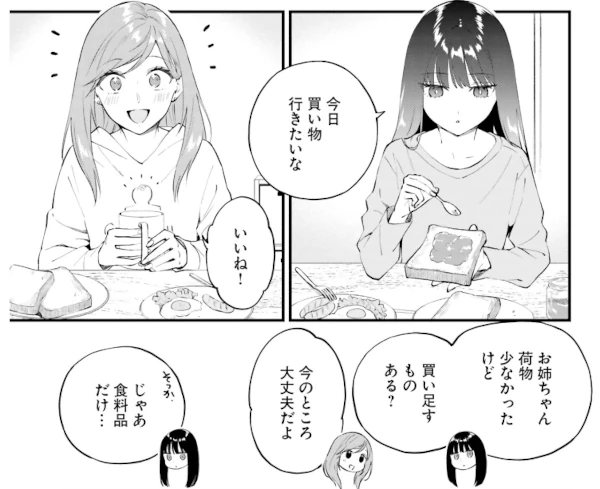
Since the story follows two women living together as sisters, many scenes revolve around ordinary domestic life and outings together.
Their conversations are similarly grounded in everyday situations and use familiar vocabulary. This makes the manga accessible to Japanese learners, including those who are still at an early stage of their studies.
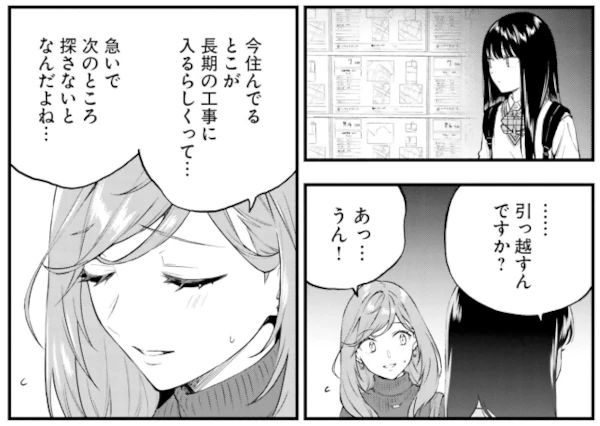
Culture Spotlight
From “ペラ紙一枚” to “ペライチ”: Understanding Everyday Japanese Expressionsペライチ
In Contract Sisters, Kasane and Meguru make a sisterhood contract using what is described as 「ペラ紙一枚」—literally, “a single thin sheet of paper.”
At first glance, this may sound like an ordinary description of a piece of paper. But the expression has a more interesting side: a shortened form, 「ペライチ」 (peraichi), is also commonly used in Japanese business settings to describe a document that fits on just one page.
This is a good example of how everyday Japanese expressions can develop into workplace terminology—and how Japanese speakers create compact, informal expressions that you might not find in a standard vocabulary list.
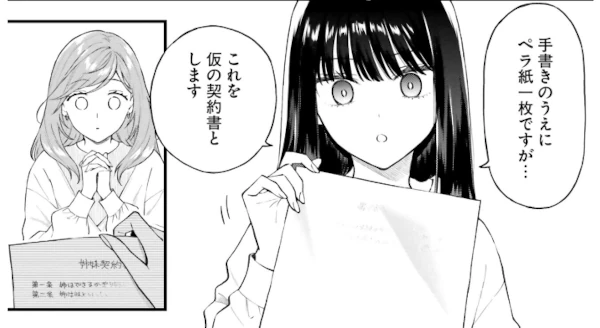
What Does “ペラ紙一枚” Mean?
The word 「ペラ」 (pera) is an informal expression suggesting something thin, flimsy, or insubstantial. When used with 「紙」 (kami, paper), as in 「ペラ紙」 (pera-gami), it refers to a thin sheet of paper.
So, 「ペラ紙一枚」 emphasizes that something consists of just one thin, seemingly insignificant piece of paper.
Depending on the context, the phrase can carry a slightly dismissive or humorous tone. For example, describing an important agreement as 「ペラ紙一枚」 may suggest that the contract looks rather flimsy or surprisingly simple for something so significant.
In the manga, this creates a humorous contrast: the two characters are making an important personal agreement, yet the contract itself is nothing more than a single sheet of paper.
From “ペラ紙” to “ペライチ”: A Business Expression
In Japanese business settings, 「ペライチ」 (peraichi) is a shortened expression referring to a document that is only one page long.
It is commonly used for concise materials such as proposals, summaries, project outlines, and explanatory handouts. Rather than preparing a lengthy report or presentation, someone might be asked to put the essential information together on a single page.
For example:
「企画書をペライチにまとめてください。」
“Please condense the proposal into a single page.”「まずはペライチで概要を共有しましょう。」
“Let’s first share the outline in a one-page document.”
The expression is informal, but it is widely understood in many Japanese workplaces. It also reflects a familiar business preference: communicating the key points clearly and efficiently, without overwhelming the reader with too much information.
One important distinction for learners: 「ペライチ」 does not necessarily mean that the paper itself is physically thin. It refers primarily to the one-page format.
Japanese Has Many Expressions Like This
「ペライチ」 is part of a broader pattern in Japanese: speakers often combine words, shorten phrases, or use familiar words in new ways to create expressions that are easy to understand in context. Some of these expressions are particularly common in workplaces.
For example:
「たたき台」 (tatakidai)
– A draft or starting point for discussion. Literally, it refers to a surface or platform used for hammering something into shape. In business, it means a preliminary proposal that others can revise or build upon.
「丸投げ」 (marunage)
– To hand over an entire task or responsibility to someone else without providing much direction or support. It often carries a critical nuance.
「前倒し」 (maedaoshi)
– To move a schedule or deadline forward, so that something happens earlier than originally planned.
「巻き取り」 (makitori)
– To take over a task, responsibility, or problem that was previously handled by someone else. It is often used when a team or individual assumes responsibility for unfinished work.
These expressions are not always easy to understand by translating their individual parts. Their meanings come from how Japanese speakers use them in particular situations.
They also show that Japanese vocabulary is not simply a collection of fixed dictionary entries. New combinations and shortened expressions emerge naturally through everyday communication, especially in professional environments.
What This Means for Learners of Japanese
For learners, 「ペラ紙一枚」 and 「ペライチ」 are useful reminders that understanding Japanese requires more than memorizing standard vocabulary.
You may encounter expressions that sound unusual when translated word for word, but are perfectly natural to native speakers. This is especially true in workplaces, where concise and informal terminology is often preferred.
It is also important to pay attention to context. 「ペラ紙一枚」 can emphasize how flimsy or insignificant a document seems, while 「ペライチ」 usually refers more neutrally to a one-page document or summary.
So, when you come across 「ペライチ」 in a business conversation, don’t imagine someone talking about a particularly thin piece of paper. They are probably asking for something much simpler: Put the important points on one page.
A Little Warning
Meguru Switches to Casual Speech in Sister Mode
When Meguru slips into her younger-sister role and acts affectionately toward Kasane, whom she treats as her big sister, she switches from polite language to casual speech (タメ口, tameguchi).
As a result, the proportion of polite Japanese in the manga is somewhat lower than you might expect.
Work Information
Contract Sisters(ケイヤクシマイ)
Author: HIJIKI
Publisher: KADOKAWA
Amount of text: moderate
Challenge level: ★★
Latest volume : Vol.6(Jun.2026/ Ongoing)
Here’s a safe and convenient way to purchase Japanese manga.
This Blog’s ConceptIn this blog, we are introducing manga that are not only highly captivating but also ideal for Japanese language learners. Studying Japanese through manga is both fun and effective. Manga allows you to understand the subtleties of keigo (honorifics), teineigo (polite speech), and casual conversation in Japanese. We hope you find works that match your interests and use them to enhance your Japanese learning journey.